CineFix Now's The Future of Bond Video
April 9, 2014- A great update video on the next Bond film and more.....
 1. Subscribers to Netflix were outraged to learn that they were losing access to all of the James Bond Film Collection, plus many more titles owned by MGM Studios, effective May 1, 2013 as a result of an attempt to foster parent company, Warner Bros.'s, competing service by making these products exclusive. This decision was bad for Netflix fans but it demonstrates that the Bond Films are still a valuable asset to any film collection.
 2. Wanna drive around town like 007? Well the opportunity to live the secret agent's lifestyle may be at hand in not just one, but two, separate sales of famous Bond Aston Martins. Sean Connery's iconic car of Goldfinger and Thunderball is yours to own for a mere $4.7 million dollars "fully loaded". If the classic is a little beyond your budget, there is still a shot at the rare, Aston Martin V8 Volante driven by Timothy Dalton in 1987's The Living Daylights for sale by Classic Driver for considerably less.
 3. Sir Roger Moore is lending his star power to celebrating the 20th Anniversary of the founding of STARS (Syncope Trust and Reflex Anoxic Seizures). This charity, an international organization, has assisted 50,000 people since it's inception who suffer from unexplained blackouts. Sir Roger suffered one such blackout in 2003 due to a later diagnosed, low heart rate. The installation of a pacemaker helped him to address this problem and he has committed himself to spreading the word about the foundation's good work. That is up there with the most heroic of Bond's deeds.
 5. George Lazenby really doesn't seem to get it at all. In a recent interview for Entertainment Tonight he talks about his decision not to return to the role of James Bond, not because he was lackluster in the role, but because the days of Bond were winding down. That was 43 three years ago, and here we are with the series making a robust comeback. In fairness to Lazenby he succeeded the iconic Sean Connery, who was inextricably linked to the character itself. He also was faced with a time period which he referred to as "the hippie era" and it was hard for him to see the clean cut Bond character competing in the movie world alongside an "Easy Rider" movie audience. Falling in step with the other Bonds, however, Lazenby did praise Craig's acting in the lead role, although he longs for license to kill who "could still shed a tear over someone dying". Maybe that is the major difference between Craig and Lazenby's portrayal of Bond; Lazenby longs for a 007 who sheds a tear with every killing and Craig, to quote Casino Royale "...wouldn't be very good at my job if I did." I am with Craig.
 5. The Living Daylights (1987): The fact is that there are elements of Timothy Dalton's portrayal of James Bond, in his first appearance as the iconic 007, that are redeeming. His edgier than Moore interpretation of the character was actually refreshing, but not refreshing enough. I struggled over determining which of the two Dalton Bond Films was more disappointing. In the final analysis, after seeing The Living Daylights, I was so disappointed that such a great opportunity to transform and resurrect the franchise was squandered, that it was hard to be more disappointed by subsequent films in the Dalton era. The essential defects revolve around an identity crisis for a franchise in transition. I think the move to a grittier Bond was a smart contrast to Moore's light-hearted hero, but the complexion of the rest of the film is not entirely in sync with this posture. Joe Don Baker's, over the top, campy, ridiculous performance as Brad Whitaker is among the worst in the film franchise's history. Maryam d'Abo's performance, like much of the film, is just flat as the Cellist Kara Milovy. Is this a terrible film-no; but the opportunities squandered at this critical time in the franchise's chronology is what is so disappointing.
 4. License to Kill (1989): While this film is better than it's predecessor, mostly due to a grittier, more Fleming based portrayal by Timothy Dalton in the lead role, the film just never really manages to impress. The plot, with loose ties to several Fleming sources, revolves around Bond seeking revenge for a brutal attack on CIA Agent and friend, Felix Leiter and his wife, by henchman of Robert Davi's Villain, Franz Sanchez, who's performance is one of the admirable parts of the film. Despite strong elements the film never seems to find it's own identity and, despite the minimization of the camp of earlier films, the film seems to just be moving along without any real enthusiasm. The fact is that, despite the flaws of Moore's last few Bond Films, he still brought his own charm to the character. In fact, his later films relied too much on that charm and not enough on other elements. The Dalton films lack dimension and character as films and Dalton disappoints because the foundations of his Bond portrayal lend themselves much more closely to the Fleming, Connery and, later, Craig, interpretation of the character but he never builds on that strong, fundamental attachment to the original character.
 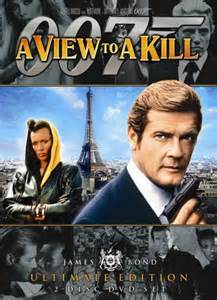 3. A View To a Kill (1985) This last installment of the series starring Roger Moore came, at least, one film too late. Named after an Ian Fleming short story of the same name, this film has nothing to do with that source work. Once again, the further the Bond films stray from the source material, in substance and in essence, the bigger the disappointment they are, in my humble opinion. Christopher Walken's portrayal of Max Zorin is the most redeeming part of the film. While many critics commented on Moore's portrayal of Bond as a 57 year old as problematic, I think the real failure was not to address the aging Bond within the context of the film, rather than dismissing the obvious and having him portray Bond as much younger character with little credibility. Tanya Roberts, Grace Jones, and Richard Kiel represent the epitome of bad acting and camp and do nothing to support this installment.
 2. Moonraker (1979): Christopher Null of FilmCritic.com said everything that needs to be said about this film, "Most rational observers agree that Moonraker is without a doubt the most absurd James Bond movie, definitely of the Roger Moore era and possibly of all time". Once again the significant variation from Fleming's source material combined with campy, comedic gags, over the top gimmicks, and two dimensional characters really disappointed. One of the most significant criticisms of the film is that it suffers from an identity crisis. While the film was released in the Star Wars era the effort to have the film compete with that genre transformed Bond, even if only for this film, from a trendsetter to a wannabe in the film industry. Moonraker could have been an exciting, action packed Moore portrayal if it tried to stay true to what made Bond movies so beloved.
 1. On Her Majesty's Secret Service (1969): This film is the greatest Bond Disappointment of all time. The source material is the second book in what has become to be known as "The Blofed Trilogy". For many literary critics the written source is the greatest of all the Fleming Bond books, perhaps setting any film interpretation up for failure. Despite the fact that the plot is very close to the original Fleming work of the same name, the execution is where the film falls short. George Lazenby, sandwiched between two Sean Connery appearances falls flat in his portrayal of Bond. His character does not have the grit or depth of his predecessor, and lacks the charm of his successors. The fight sequences are not well choreographed, the music is more suited to a 70's romance, and the film-making is "B-Movie" quality at best. I have tried to watch and re-watch this film over the years with an open mind but it does not improve with age. Perhaps I judge this film too harshly, but I loved the novel and I loved Connery as Bond and this installment diverges so far from either of those that it may not be the worst but it is the most disappointing, by far.